
Configure SSL Parameters
Copy all three PEM files to the folder where your uniGUI server executable is deployed.
You also need the OpenSSL standard DLL library files:
libeay32.dll
ssleay32.dll
These DLL files are distributed as part of the OpenSSL installation. You can also find the most recent version of OpenSSL DLL files under the folders:
[UniGUI Installation Folder]\..\Framework\uniGUI\SSL\dll\x86
[UniGUI Installation Folder]\..\Framework\uniGUI\SSL\dll\x64
Depending on how you deploy your app, you can copy them under the Windows system folder (such as C:\Windows\System32) or put them in the same folder as your uniGUI server.
There is a chance these DLL files are already installed by other programs and present in your system PATH. In that case, make sure you have the most recent versions.
Now you need to configure your server to use SSL. Open your project's ServerModule and make the following changes.
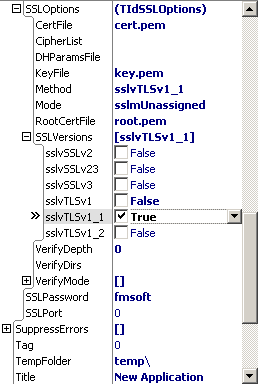
2. Configure SSL port or use ServerModule port
You can leave SSL port to its default value of 0. In that case the server uses the port configured in ServerModule->Port (default 8077).
Example access when using default ServerModule port: https://localhost:8077
Alternatively, use the default SSL port 443. If you set ServerModule->Port = 443, you can omit the port number in the address:
https://localhost
SSL/TLS evolves continuously. TLS has largely replaced old SSL versions. Follow the latest security requirements for your network and browsers and change SSL/TLS versions if needed. The uniGUI distribution periodically updates the SSL DLLs to stay current with protocol changes and improvements.